Connect a Phone, Tablet, or Laptop
You do not need a MIDI controller to use Pad-Lattice. A phone, tablet, or laptop browser can become a live control surface for Codex.
Connecting another browser does not start another agent. Every connected screen mirrors the same Pad-Lattice daemon, selected Agent Scene, state, and available actions. Selecting a Scene on one screen changes it on all screens.
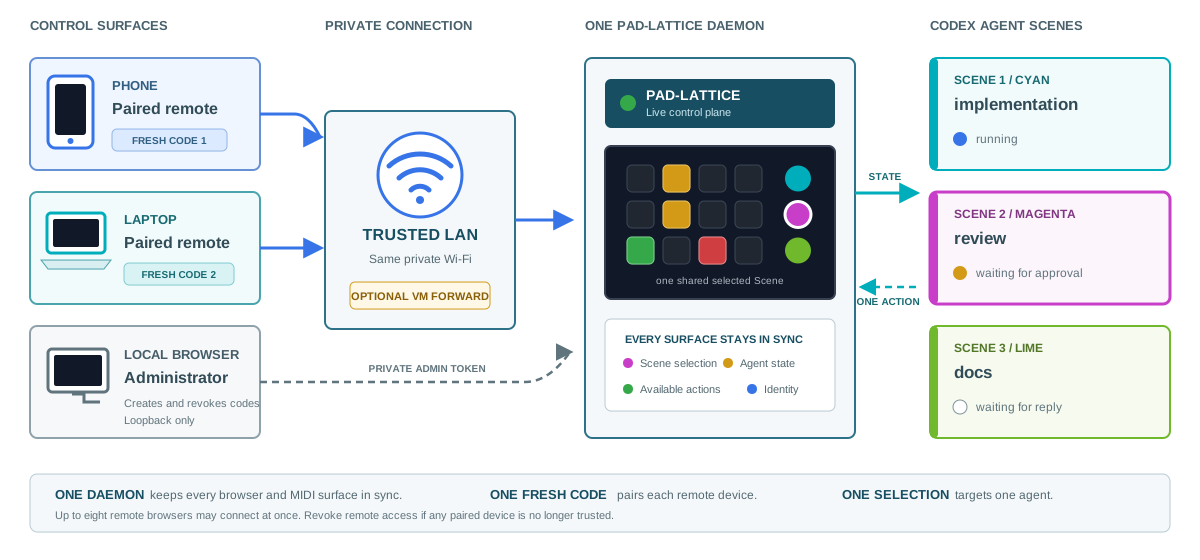
Open the connection diagram at full size.
Before You Start
You need:
- Pad-Lattice installed on the computer that runs Codex;
- the computer and remote devices on the same trusted private network;
- one terminal window for Pad-Lattice and another for Codex;
- a modern browser such as Chrome, Chromium, Firefox, or Safari.
Avoid public or guest Wi-Fi. Some guest networks prevent devices from seeing one another.
Connect the First Device
1. Start Pad-Lattice
On the computer that runs Codex:
pad-lattice web --lan
Leave this terminal open. Pad-Lattice prints three useful items:
Local admin:   http://127.0.0.1:8765/#admin=...
Phone/tablet:  http://192.168.1.20:8765
Pairing PIN:   123456 (expires in 5 minutes)
The exact address and PIN will be different on your computer.
2. Keep the local page open
Pad-Lattice opens its administrator page on the Codex computer. This page shows a QR code and can create or revoke pairing codes.
Do not share the Local admin URL. It contains the administrator credential
for this daemon.
3. Pair the phone, tablet, or laptop
On the remote device, either:
- scan the QR code shown on the local administrator page; or
- open the printed
Phone/tabletaddress and enter the six-digit PIN.
The screen should change to Connected to Codex. Each QR code or PIN can be used once and expires after five minutes.
4. Start Codex through Pad-Lattice
In another terminal on the Codex computer:
pad-lattice codex --label work
The work Agent Scene appears on every connected surface. On the first launch,
use /hooks inside Codex to review and trust the scoped Pad-Lattice hooks.
Use the normal Codex session ID after resume:
pad-lattice codex --label work -- resume <SESSION_ID>
An already-running plain codex process cannot be attached afterwards. Resume
it through pad-lattice codex instead.
Add More Browsers
Pad-Lattice supports the local administrator plus up to eight remote browser connections at the same time.
For each additional phone, tablet, or laptop:
- On the local administrator page, choose New code.
- Scan the new QR code or enter its new PIN on that device.
- Wait for Connected to Codex before pairing the next device.
A code consumed by the first device cannot pair the second one. Generate one fresh code per device.
All connected devices can select Agent Scenes and invoke currently lit actions, including request-scoped Approve and Reject. Coordinate with anyone holding a paired device; there is one shared selection and one shared action target.
Share Demo and Show
The local administrator page can start Demo or Show while the normal
live daemon is running. The same experience appears on every connected
browser and, with pad-lattice daemon --web, on the Launchpad too.
- Only the tokenized local administrator page can start or stop an experience.
- Paired phones, tablets, and laptops can answer Demo Scene/action prompts.
- Show is synchronized and read-only on paired devices.
- Sound is independent on each browser and starts muted; one device's toggle
does not affect another device or the host
--audio-feedbacksetting. - A real agent waiting for a reply or approval immediately interrupts Demo or Show and restores the live agent display.
This ownership rule prevents a paired remote from replacing operational state with a performance, while still allowing several people to experience the surface together.
Pairings last only while the daemon is running. Revoke remote disconnects every remote browser at once. Per-device revocation is not currently available, so revoke all devices and pair the trusted ones again if a device is lost.
Running Inside Parallels Desktop
Parallels Shared Network lets the virtual machine reach the network, but it normally prevents phones and other computers from reaching the VM. Parallels Desktop Pro can forward one TCP port from the Mac to Pad-Lattice without putting the whole VM in bridged mode.
The example below uses port 8001.
1. Find both private addresses
Inside the Linux VM, run:
hostname -I
The Shared Network address commonly starts with 10.211.55. In this example,
the VM address is 10.211.55.4.
On the Mac, open System Settings > Wi-Fi > Details > TCP/IP and note the
IPv4 address. In this example, the Mac address is 192.168.1.45.
2. Add the Parallels forwarding rule
Open Parallels Desktop > Preferences > Network > Shared, then add a port forwarding rule:
| Field | Value |
|---|---|
| Protocol | TCP |
| Source port | 8001 |
| Forward to | the Linux VM or its 10.211.55.4 address |
| Destination port | 8001 |
Use the same source and destination port. The official Parallels Network Preferences guide shows where these fields are located.
3. Start Pad-Lattice inside the VM
Replace the example addresses with your own:
pad-lattice web --lan --port 8001 \
  --bind-host 10.211.55.4 \
  --advertise-host 192.168.1.45
Here, --bind-host is the VM address where Pad-Lattice listens.
--advertise-host is the Mac address that phones can reach.
4. Open the Mac address on each device
For the example above, open:
http://192.168.1.45:8001
Enter the printed PIN, then repeat Add More Browsers for each additional device.
The Parallels rule crosses only from the Mac to its VM. Do not add router port
forwarding, expose port 8001 to the internet, or use this setup on public
Wi-Fi. LAN traffic is authenticated but not encrypted.
What You Should See
| Screen | Meaning |
|---|---|
| Connected to Codex | Browser pairing and live synchronization work. |
| No active agents | Pairing works; start Codex with pad-lattice codex. |
An Agent Scene such as work | That Codex session is registered. |
| A lit Approve or Reject action | The selected session has a live permission request. |
| Dark actions | No compatible action is available for the selected session. |
Quick Troubleshooting
| Problem | Check |
|---|---|
| The page does not open | Confirm both devices use the same private Wi-Fi; temporarily disconnect VPNs and check the computer firewall. |
| A VM address opens only inside the VM | Use the Parallels forwarding setup or bridged networking. |
| The PIN is rejected | Create a new code; codes are one-use and expire after five minutes. |
| The browser connects but shows no agents | Launch or resume Codex with pad-lattice codex, not plain codex. |
| The second device cannot use the first PIN | Generate a separate code for every device. |
| A previously paired browser stopped reconnecting | The daemon restarted; pair it again. |
For less common problems, see Troubleshooting and the Security Model.