Architecture
Pad-Lattice separates agent integration, deterministic policy, and surface translation. A browser and a MIDI controller are peers at the surface boundary; neither owns agent state or decides where an action goes.
Read the Developer Guide next for end-to-end code paths, failure behavior, and the change map.
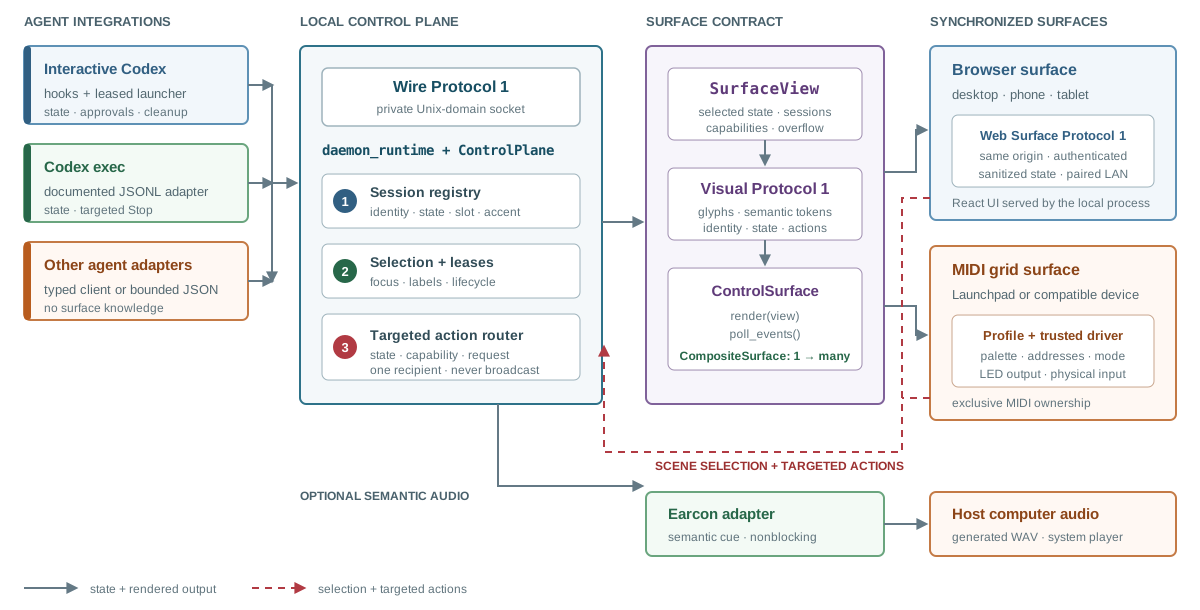
State flows from agent adapters to every enabled surface. Scene selections and actions return through one capability-gated router.
Design Boundaries
- Agent adapters know agent events and Wire Protocol 1, but not browser layout, LED colors, or MIDI addresses.
ControlPlaneis the sole authority for sessions, selection, leases, overflow, action capability gates, and action targets.PadLatticeDaemonadapts sockets, clocks, rendering, and surface input to that policy.SurfaceViewis the stable semantic boundary between policy and rendering.- Visual Protocol 1 turns semantic state into glyphs and light tokens without knowing whether the output is CSS or MIDI.
- The browser adapter authenticates clients and exposes only sanitized surface state. It does not expose Wire Protocol 1.
- Device profiles and trusted drivers translate semantics into hardware I/O; they know nothing about Codex events.
These boundaries let a new agent backend, browser client, or physical device evolve independently.
Components
| Module | Purpose |
|---|---|
pad_lattice.events | Agent identities, semantic states, and actions. |
pad_lattice.protocol | Typed Wire Protocol 1 commands over bounded JSON lines. |
pad_lattice.client | Public Python API for agent integrations. |
pad_lattice.control_plane | Deterministic sessions, slots, selection, leases, previews, and action routing. |
pad_lattice.daemon_runtime | Unix socket selector loop, surface polling, and rendering adapter. |
pad_lattice.devices.base | SurfaceView, semantic input events, and the ControlSurface contract. |
pad_lattice.devices.composite | Compatible multi-surface fan-out and event merge. |
pad_lattice.visual_protocol | Device-independent glyphs and semantic light tokens. |
pad_lattice.web_protocol | Narrow, versioned browser command and rendering contract. |
pad_lattice.web_surface | Static app server, WebSocket authentication, pairing, and browser event queue. |
pad_lattice.experience_manifest | Dependency-free Version 1 Demo and performance manifest loader. |
pad_lattice.experience_runtime | Nonblocking Demo graph and absolute-time Show playback shared by standalone commands and daemon. |
pad_lattice.experience_compiler | Authoring-time compiler for the performance manifest and browser WAV assets. |
pad_lattice.devices.profiles | Dependency-free device-profile parsing and catalog. |
pad_lattice.devices.midi_grid | Trusted palette-grid driver with optional show-only RGB SysEx. |
pad_lattice.identity_store | Bounded LRU of hashed identity-to-accent preferences. |
pad_lattice.audio | Optional semantic earcons, WAV synthesis, and system-player output. |
pad_lattice.codex_hooks | Interactive Codex lifecycle adapter and scoped-hook configuration. |
pad_lattice.codex_session | Native-terminal Codex launcher and reconnecting lease. |
pad_lattice.codex_exec | Non-interactive Codex JSONL adapter and Stop sink. |
One Control Plane, Many Surfaces
ControlPlane.surface_view() produces one immutable semantic snapshot. A
single surface renders it directly. CompositeSurface sends the same snapshot
to each compatible child and merges their ActionPressed and
SessionSelected events.
Compatibility is explicit: children must have equal selector capacity, accent order, and Visual Protocol version. Initialization rolls back already-opened children if a later child fails, and shutdown closes children in reverse order.
Both browser taps and MIDI presses therefore enter the same control-plane method. They do not choose a socket client themselves. Selection, current state, live capability, request ordering, and debounce checks still determine whether one subscriber receives an action.
Execution Model
The daemon uses one synchronous selectors loop for authoritative state. On
each iteration it expires sessions, renders dirty state, handles Unix-socket
clients, and polls surface event queues. The control plane receives an explicit
clock value, keeping policy deterministic in tests.
The browser HTTP/WebSocket server runs in an adapter thread because client connections wait independently. It compiles no policy. Browser commands become semantic events in a thread-safe queue, which the daemon consumes on its next poll. Rendering travels in the opposite direction as a compiled, sanitized surface message.
MIDI polling remains in the daemon loop. Optional audio starts nonblocking system-player processes and cannot change routing decisions.
Shared Demo and Show Pipeline
Python remains the expressive authoring source for the visual story and score, but neither runtime executes that authoring code independently. The asset compiler produces a compact Version 1 performance manifest, exact RGB frames, one synchronized browser soundtrack, and the browser earcon bank. This deterministic build boundary is the experience asset compiler. The guided Demo is a Version 1 stage graph of semantic views and transitions. The browser build copies both manifests and audio into the packaged application.
At runtime, Python loads the packaged artifact through small structural
parsers; TypeScript consumes the same JSON. ExperienceController advances
Demo transitions from SessionSelected and ActionPressed events, and chooses
Show cues from absolute monotonic time. A delayed iteration skips stale Show
cues instead of accumulating timing drift.
Standalone demo and show commands use that controller directly. The live
daemon embeds the same controller in its normal selector loop, so sockets and
surface input remain responsive. Any real agent in waiting_for_reply or
waiting_for_approval preempts playback and forces an authoritative semantic
render. Only a loopback administrator may send browser start/stop commands;
paired clients may answer Demo inputs and receive Show frames.
See Experience Asset Compiler for the complete authoring, compilation, validation, and playback path.
Protocols and Schemas
Pad-Lattice has versioned contracts with different audiences:
| Contract | Audience | Carries |
|---|---|---|
| Wire Protocol 1 | Trusted local agent integrations | State, identity, leases, inspection, subscriptions, targeted actions. |
| Web Surface Protocol 1 | Authenticated browser clients | Compiled visual frames, sanitized labels, Scene selection, actions, pairing administration. |
| Visual Protocol 1 | Any conforming surface | Glyph shapes, semantic colors, identity accents, actions, and overflow. |
| Demo Manifest 1 | Python and browser experience runtimes | Prompt stages, semantic views, and allowed transitions. |
| Performance Manifest 1 | Python and browser experience runtimes | Exact full-surface frames, absolute cue durations, palette, and audio metadata. |
Device Profile Schema 1 translates the visual contract to trusted MIDI-driver data. Packaged JSON Schemas document the two transports, device profiles, and both experience manifests for editors, CI, and conformance tooling. Runtime code uses small typed parsers instead of general schema validation in live paths.
See Socket Protocol, Browser Surface, Visual Protocol, and Device Profiles.
Browser Security Boundary
Loopback browser clients must present the daemon's random administrator token. LAN clients receive no state before presenting a valid one-use pairing secret, PIN, or in-memory session token, and the LAN listener binds only to the selected private interface. The server also checks Host and same-origin WebSocket headers, disables CORS, caps frames, bounds clients and pending events, rate-limits failed PINs and authenticated commands, and serves a restrictive Content Security Policy.
Only labels, states, slots, accents, available actions, overflow, compiled light tokens, and explicit Demo/Show lifecycle data reach the browser. Show adds exact full-surface RGB frames; Demo adds its built-in prompt text. Real agent prompts, responses, terminal output, full working directories, raw Codex events, and arbitrary Wire Protocol commands do not.
Pairing authenticates control but does not encrypt LAN traffic. The supported network scope is a trusted local network, never an internet-facing port. See the Security Model for the complete threat model.
Platform Scope
Agent integrations currently use Unix-domain sockets, so real Codex control is supported on Linux and compatible Unix-like systems. The public browser demo runs anywhere with a modern browser because it is a deterministic simulation. The virtual live surface broadens the client device to desktop, phone, and tablet, but it does not move the agent daemon away from the local Unix host.